The absolute state of Sweden in 2025
November 08, 2025 | View Comments
I had a call with a friend back in Austria yesterday. And here's a pattern: When I tell my friends back home anecdotes about things that I or friends experience here in Sweden, they are usually in shock or absolute disbelief. This blog post is about some of my experiences living in Sweden now for more than four years; it's about the absolute state of Sweden in 2025.
In this blog (the first of what may become a series), I'll touch upon several topics that concern Sweden in 2025:
Topics
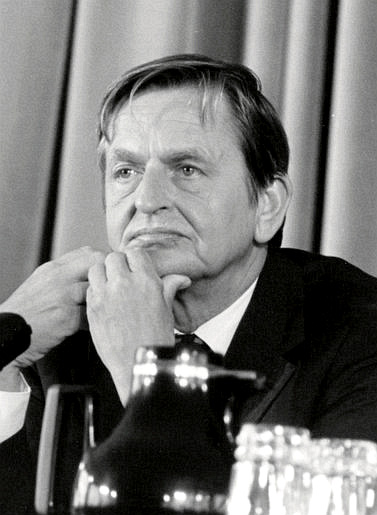
Olof Palme in 1984, two years before he was shot under still unresolved circumstances. His death might have been the turning point to the worse in this country. Photo attribution: © Ministry of the Presidency. Government of Spain.
But let's talk about yesterday's conversation with my friend first. The usual impression of Sweden among foreigners still reflects the state of Sweden maybe 20 years ago. Maybe even going back further to the times of real social democracy in Sweden, back to the times of Olof Palme and friends. Palme sadly died in 28 Feb 1986 under mysterious circumstances. An event that I believe led to the slow downfall of Swedish social democracy, its society's ideals and values, Sweden's social services and public institutions, and healthcare. Today Sweden feels like a dog-eat-dog place, at least from the perspective of an expatriate living with children for four years in the city of Malmö, a city that some jokingly refer to as Crime City, but there's a much darker side to this joke. Let me explain.
Warning
"It's easy to be cold," says a song from the Hair musical. This is a critique of Swedish institutions and policy, not of individuals. But institutions are made of individuals, and "just doing my job" has limits. If something here offends you, consider whether it's the critique or the system being critiqued that's the problem. This blog post might be for you if you're considering moving to Sweden permanently in 2025. (Consider Finland or Denmark instead.)
Healthcare
Beyond the widely shared memes about Swedish healthcare, there's some incidents that happened to myself or friends that I want to share here.
Hospitals
A while back I felt really sick and asked a friend to drop me at Kvälls- och helgmottagningen Södervärn so I could get a check-up. Did I have a flu? I had strong fever, headache, the usual symptoms of a flu. And usually I'll stay at home and let it resolve, but the high temperature sustained over the course of many days wasn't usual. So there I tried to register myself at the reception at the evening hospital: Oops, I had forgotten my social security card, but guess what, I had a phone with me with a photo of it, and my 'BankID,' which is the digital way of identifying yourself in Sweden across healthcare, banking, and online services of city and state. Still that didn't seem to fare very well. When I insisted to the receptionist that I wanted to see a doctor and that I was willing to wait as long as it takes (there wasn't a big queue of people after all), the receptionist insisted that she take my temperature, and after she did, through the glass, she insisted that I should go home. No doctor for me.
In a sharp contrast to this experience, when in Austria I went to the hospital to diagnose and treat shingles and a laceration of the capsule this Summer, I was seen by a doctor the same day, treated with some sort of plaster, advice on how to treat it further with referral to a pharmacy. As for the shingles, I got a proper diagnosis with a blood test and the appropriate medication. All in the same day! And here's the kicker: I didn't even have my social security card from Sweden with me, nor my European health insurance card. By the way, I had similar experiences when I lived in Portugal a while back: free healthcare, no questions asked.
Now fast forward a couple of weeks and the Austrian hospital sends me an invoice for their services. I ignore the first letter because I have lots to do. The second reminder comes in and I call up services in Sweden. The result? I can pay the costs out of pocket and send in the invoice from Austria, and someone would check if I was liable for a refund. Let that sink in.
Then I had the crazy idea of calling the Austrian hospital. The outcome was that they put their invoice on halt (no more reminders), while promising to take care of the matter and contact Swedish healthcare directly! That's social democracy for you. The other is a healthcare system that's been hollowed out: understaffed, and increasingly dependent on private staffing agencies and short-term consultants. Public money, private pockets. From a patient's point of view, the result is a gatekeeping system: send people home first, escalate only when things become undeniably serious. Whether by design or by budget, the effect is the same.
The other incident I want to tell you about is that of a friend whose child had a condition of the spine, leading to back pain and abnormal posture. As it turns out in their specific case, the traditional medical approach is to treat with a night brace. The treatment is also very time critical in children that have lots of growth left.
My friends experience at Skåne University Hospital, the third largest hospital in Sweden? The doctors examined the child about a year back and detected the child's condition, called Scoliosis. Again, the standard approach is to observe the development of the spine every three months, even in Sweden. What happened instead? The initial referral from last year, after the first diagnosis, was lost, leading to huge delays. The child was called in back again after a full year, instead of three months, after the child's school nurse had found out that no treatment plan was made, and therefore called up the hostpital again. The hospital reacted with doing another examination, which revealed that the child's condition had progressed within that year. The doctor's reaction who by the way was also a consultant and not employed by the hospital? It wouldn't have mattered. We wouldn't have done anything anyway. It's fine, just wait it out. Physiotherapy? Well the child can have some physiotherapy although it probably won't help. But I can give you a therapy session of 15 minutes every three months or so. But believe me, it's really useless. When it gets worse, we'll operate her. Note that operation usually involves limited mobility for the child in this case, as well as a stay in the hostpital that is many weeks long, post-OP.
The parent, not satisfied with the solutions offered by Skåne University Hospital, did his own research and found out that the treatment offered differs wildly from standard care procedures. That does not only concern the lost the referral part. To add insult to injury (or the other way around), even after the second examination revealed a progression, the doctor decided to just let it be. My friend reached out to Sahlgrenska University Hospital to find out that the doctor there recommends immediate treatment with either a night-time or day-time brace, that all indications are that the treatment should begin immediately. My friend filed a complaint against Skåne University Hospital, and the child will eventually be fine with the proper treatment that they will be getting now, but a taste of disgust will likely never leave my friend's mouth.
Note
If you are press or a concerned parent and you want to learn more about this case, feel free to contact me.
Psychiatry
Last year, by sheer accident, I met a new friend on the streets of Malmö. A young, sporty looking woman in her mid-twenties and I came into a conversation. I learned that she had just been released from on of same Skåne University Hospital's psychiatric units, called Vuxenpsykiatriavdelning 88 psykos Malmö. And what I learned about this girl shocked me to my core. Let's call her Vicky, it's not her real name. I learned that she had been released from said psychiatric ward, where she had received psychotropic drugs in high doses and on a regular, out onto the streets from Malmö, basically without any after care of proper attention to what will happen to her after she was released. But let me explain what I mean.
Vicky was on psychotropic drugs, against her anxiety and perhaps psychosis, and she had a receipt to collect her drugs from the pharmacy. But it turns out that at the time that Vicky was released from the psychiatry, she was not in posession of a proper ID, which means she couldn't identify herself at the pharmacy, something that is a requirement if you want to collect prescription drugs here in Sweden. When she had tried to receive her drugs from the pharmacy, the reaction of the pharmacist was usually: not my problem. And I found out that this attitude is prevalent among Swedish institutions.
Further, I found out that Vicky only had a friend, maybe an ex-boyfriend, to stay with. Was she assigned a social worker from Malmö to allow her to get her life back under control? Yes. Did that social worker invite her soon after she was released? Was she invited frequently to chat with someone? Did she get any psychological help within the psychiatric ward or outside that extended beyond given her her prescribed drugs? Absolutely not. What a shock that was for me to find out...
But it continued. I offered her a room in my apartment and she stayed there for a while, so I could exactly observe what happened and most importantly what did not happen. Meetings with the social worker from Malmö City only happened on the phone, maybe in intervals of one week. Was she referred to other centres or institutions to talk to others or reintegrate into society after her time out? Not at all. The only thing that Malmö Stad offered was essentially brief, check-the-box calls with her social workers and a little money in cash, but only under conditions which I didn't really know about. The lack of a social safety net for Vicky was absolute daunting. No ID card, no place to stay, no access to medication, no psychological supervision. This is the state of Swedish healthcare.
And it continued. When I took care of her and bought her a phone (!) so that she could communicate again with the world properly, including her social worker, we decided to some day visit the others held on the ward, because that was where she actually found some friends and wanted to chat and talk and see how everyone was doing. When I entered the ward with her, I had my next shocking experience.
It also turned out that Vuxenpsykiatriavdelning 88 psykos Malmö or, for short, Avdelnging 88, had some spectacularly bad taste in symbols. The number 88 is a well-known neo-Nazi code for 'Heil Hitler,' and in Austria the deliberate use of '88' or the Hitler salute can fall under Wiederbetätigung, the crime of 're-engaging in National Socialist activity' under the post-war Verbotsgesetz. The ward's number was obviously present everywhere (though there's also ward 87), but what really put me off was a toilet sign which showed a little 'shower man' with his arm stretched up in what looks uncomfortably like a Hitler salute. I obviously can't prove anyone sat down to design Nazi bathroom art; the most likely explanation is a sick in-joke or complete cluelessness that nobody higher up ever questioned. But the fact that this passed as normal in a locked psychiatric ward in 2024 says a lot about the culture.
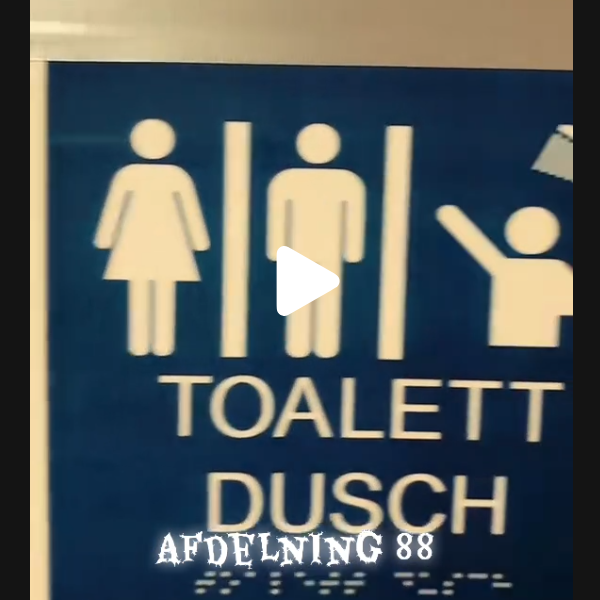
Highly problematic iconography used in Vuxenpsykiatriavdelning 88 psykos Malmö. Photographed by myself in 2024. Free use.
Now consider that this isn't just a normal rehab. This is a locked psychiatric ward. People can be held here for months under compulsory treatment, medicated whether they consent or not. What struck me was what happens after: discharge without a workable plan for basics like ID, housing, or continuity of care. The system takes people in, medicates them, and sends them back out to fend for themselves.
And Vicky's story is not an outlier. The IVO investigation that Läkartidningen recently reported on concerns nine people who had been treated within Malmö psychiatry and who died by, or are suspected to have died by, suicide over a little more than a year, several of them during inpatient care or soon after discharge. The authority responded by putting the service under year-long special supervision. For anyone who wants more than my anecdote, Vårdfokus' piece on IVO's serious criticism of Malmö psychiatry, SVT's Uppdrag granskning on Filip's suicide on a criticised ward, and Omni's tag page Vanvården i psykiatrin i Malmö give a pretty good view of the wider mess.
Note
If you are press or a concerned person and you want to learn more about details about Vicky's case, feel free to contact me.
A little history of psychoanalysis in Scandinavia
Som vel ingen psykolog før ham, betoner derfor Freud den uhyre betydning som barndomsoplevelser og barndomsindtryk har.
If you want to go down the rabbit hole of the connection between Swedish and Nazi German race ideology, eugenics, and psychiatry, I recommend Swedish historian Maja Hagerman's article Herman Lundborg and Germany, who writes how concrete methods used in Germany were brought from Sweden, and that the Uppsala institute of race-biology, the first of its kind, became part of an international network that influenced Nazi thinking.
The glaring absence of any analysis within Swedish institutions for the mentally ill, such as in Malmö's Vuxenpsykiatriavdelning 88 today, may have been predicted as far as 1923, when Sigmund Freud noted that Scandinavia was where psychoanalysis met its strongest resistance.
Jekels, an Austrian Jewish analyst close to Freud, spent almost three years in Stockholm in the early 1930s, but left with a sense of defeat and frustration, complaining that Swedes only pretended to practice analysis and lacked real motivation to learn. Likely, Székely, a Jewish Hungarian psychologist, spent decades in Sweden but never got a university post, and late in life felt excluded from Swedish academia despite being central in clinical psychoanalytic training.
Per Magnus Johansson, a Swedish psychoanalyst writes in a recent essay:
Psychoanalysis has [...] been accused of pansexualism, of encouraging sexual promiscuity, of being a Jewish science [judisk vetenskap] and perhaps suitable for those who live in southern Europe but hardly applicable to those who live in the north. At the same time it has, conversely, been said to suit the Nordic population but hardly the Latin.
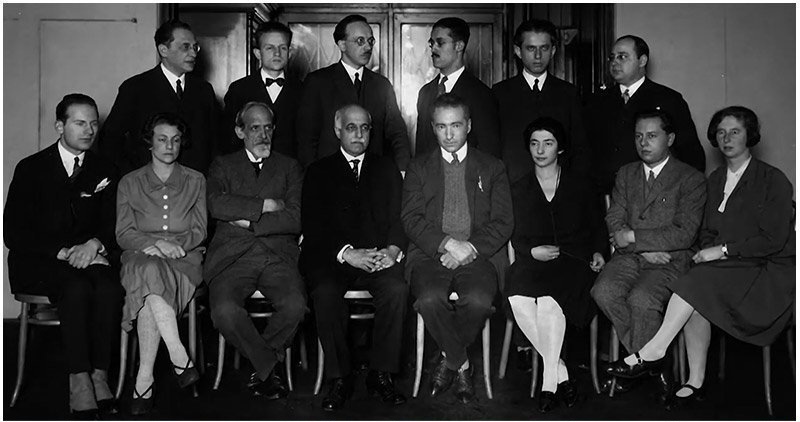
Ludwig Jekels (third from left, bottom row) at the Vienna Psychoanalytic Ambulatorium in 1922
This historical aversion to depth psychology may help explain why Swedish psychiatric care today focuses almost exclusively on medication and containment, with little attention to talk therapy or aftercare.
Pedagogy and childcare
My first-hand experience with pedagogy and childcare in Sweden has been rather devastating. I don't pretend I'm an expert in pedagogy myself, but as an enthusiastic father I've learned through experience bringing up my children and through my own research a couple of things that I believe to be important for children:
- Age-appropriate activities to support mental and bodily development
- Healthy routines as a way to build strength within mind and body
- Too much screen time as a considerable cause of anxiety, especially in girls growing up to become adolescents
- Creative activities such as music, drawing, and writing as a way to let children process the world around them
You don't have to read pedagogy to understand what's good for your children. Observing your children and knowing them well growing up, and common sense, will go a long way. That type of parenting and knowledge derived from it seems to beat an overworked, underfunded, and undereducated childcare and school workforce in Sweden in 2025 any time.
Now I hear you saying, but isn't Sweden considered a flagship model of childcare and education? Sadly that's no longer the case since neoliberalism took hold, maybe since a decade or two now.
The famous Pippi Longstocking, the fictional main character in a series of Astrid Lindgren's books. Lindgren would surely roll over in her grave if she knew about the state of childcare in Sweden today.
Some facts about parental leave and childcare in Sweden
Swedish work culture and labour laws are very favourable towards parents. Sweden pioneered a gender-neutral parental leave system in 1974. The current policy provides 480 days of paid leave per child, with each parent allotted 90 non-transferable days. This model is a key driver for encouraging fathers to take leave.
After parental leave, parents are supported by an accessible childcare system. Children are guaranteed a place in nusery school from the age of one. The seamless transition from parent leave to kindergarten enables especially mothers, to return to work.
Swedish fathers are relatively active in taking parental leave, using about 30% of all paid leave days. This is higher than in most European countries, despite laws in countries such as Spain being equally supportive. In Norway, about 90% of fathers take parental leave.
Most children start pre-school at around age one. Now all of this sounds like a great idea on paper, yes? Surely gender equality is something noble, and the idea that mothers can support their careers is great, too. However, here's the kicker: this whole model hinges on one thing, that rarely makes the equation: the quality of service and work done in kindergartens.
Perhaps related, there's the breastfeeding trends: Despite 98% of Swedish mothers intending to breastfeed, exclusive breastfeeding rates have declined. By the time an infant is 4 weeks old, the exclusive breastfeeding rate in Sweden is 67%, down from 82% a decade ago. This decline occurs despite extensive parental leave, with research suggesting contributing factors such as early introduction of formula, cultural shifts, and challenges in healthcare support.
Kindergarten
But let's talk a little more about what I perceive as a recent decline in the quality of childcare and kindergartens. Because guess what, any mother or father who gives their child to kindergarten at the age of one, absolutely depends on the quality of said childcare for a healthy development of the child. And sadly, it looks like with current Swedish policies around cutting down on education, childcare has drastically declined in general, recently.
I recently took a walk around the neighborhood with my 11-year old to get some food for our new pet. On the way, we passed a local, large Swedish preschool called Lindens förskola. Being in gender-equal Sweden, we saw a lot of dads pushing strollers with toddlers. So far so good.
But then we went around the kindergarten's yard (which was okay since I had a kid with me myself), we had a chance to take a look inside, and what we saw was a large room or hall with no toys, no noticable furniture, or other purposeful items, except for one: a very large projector on one end of the room. There were no kids inside at the time, but it was easy to imagine this being used as a large-scale babysitter: toddlers parked in front of a screen instead of doing play-based activities that build social and motor skills. Screens are cheaper than staff. That's the logic.
Again, coming from Austria, and with my own children having attended kindergarten in both New York and Berlin, the difference was striking, and it was absolutely unthinkable that such a large TV room would exist in a preschool, for seemingly obvious reasons. The room was evidently designed for frequent use, as it was in the ground floor, with ample space, and a very modern-looking, large projector.
The idea that such a TV room would support in any way the development of a toddler seems absurd to me, yet this is the argument that's been made with the less-than-recent introduction of technology such as tablets, computers, and projectors in Swedish preschools, some of it as a mandatory part of the curriculum.
Now this impression of ours was supported by a similar experience of a friend from Berlin, who also described his disbelief in the face of such practice in kindergartens, saying that such routine use of screens and projectors would never be accepted in Germany, not even in the most modern-thinking or tech-friendly of kindergartens.
Now I did a bit of research and it turns out that a large web survey of 1511 preschool teachers run by Förskolan (Sveriges Lärare) asked in 2023: "From what age are children introduced to digital tools in your preschool?" The answers:
- From 1 year of age: 59.9%
- From 2 years: 19.2%
- From 3 years: 14.6%
- Never: 2.7%
Allow me to say that similar to the parent putting their kid behind an iPad to keep them still, which sometimes as a parent might seem necessary, though there are alternatives, I believe that the introduction of screens to preschools under the pretense of allowing children to grow up and become 'tech-savvy' or whatever, has a similar underlying issues, namely that tech serves as a cheap babysitter. And while parents can make this deliberate tradeoff themselves, having understaffed kindergarten personnell place toddlers in front of giant screens is certainly not in the spirit of Sweden's exemplary childcare of only a few decades ago. And so, to summarise: while some of the foundations of childcare remain, and Swedish toddlers will go to kindergarten full-time at the age of one, providing great support to parents and worklife, their children fail short of proper pedagogy and upbringing, developing maybe issues with cognitive development that surface again later in school.
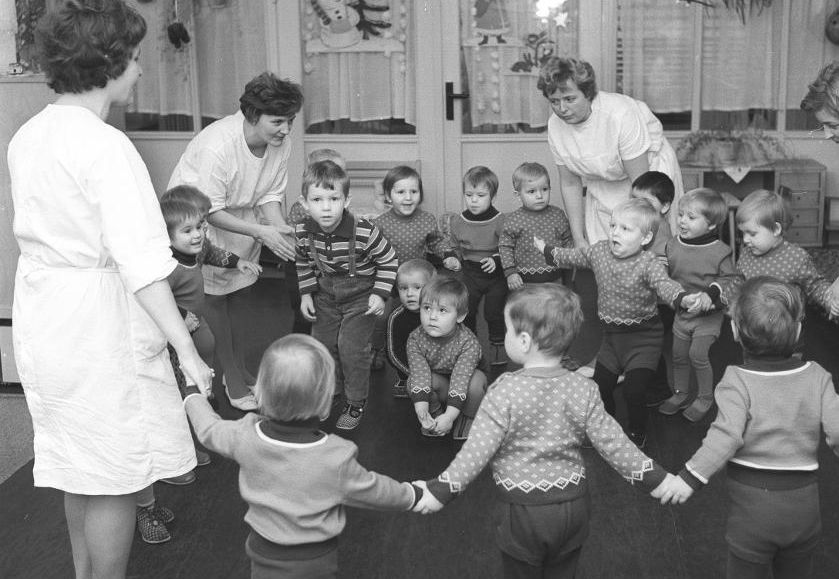
Photo of a preschool in the former GDR. Source on X
Screen use and handwriting in primary school
Similarly to preschool, media, computers, tablets; screens in general have been pushed big time in Swedish schools starting with primary school. This is not just my impression. Sweden has also had a public backlash against tech-heavy schooling, with the schools minister calling for a return to textbooks and handwriting and less screen use in early years (The Guardian, 2023).
I mean sure, electronics and the internet, they are a big topic, but here's some thoughts on that and why the current Swedish model of educating children to work with computers and use other devices is severly lacking on several fronts.
Primary school pupils use software and hardware that are evidently sponsored and provided by big-tech US companies. This looks less like pedagogy and more like procurement-by-default: vendor lock-in, product placement, and a school system leaning on whatever big tech offers cheaply. My own children learned in school what Google is before they would understand the difference between a mouse and a trackpad, a browser and a search engine, or Wi-Fi and cellular networks.
At the age of 11, the use of apps like Google Docs and Google Classroom are daily and prevalent. All the while, the kids' curriculum evidently does not include some of the essentials around working with computers or phones. Here's some anecdotal evidence for that:
They don't learn how to use a computer keyboard properly; they will type with two fingers despite doing a good part of their work on a computer, and despite children's inherent ability to develop motoric skills quickly.
They do not learn to be mindful about screen time. That is, the phones are being taken away while at school (though maybe not in daycare), however there's no notion of screen usage being harmful if it exceeds an hour or so daily, after school. The classmates of my ten-year old will routinely only hang on their screens when they meet each other to play. And it's evidently only me, and a few other parents who are aware or worried that this might be harmful. Certainly it's not part of Swedish curriculum at this age to help them understand that Google and YouTube and other tools that they learn to use at school, that they have their place. And that TikTok and Roblox should probably not be used for many hours every day; certainly not part of the curriculum, and so telling them about screen time is a job that's left to stressed out parents, some of which are overwhelmed with the kids' phone addiction, and some of which enjoy the calm when their kids are online...
So while the use of electronic devices at school is being rationalised as maybe preparing children for a changing world (we used computers too back then!), I believe that those goals are a thinly veiled way, and poorly executed, to feed Swedish school children with hidden advertisement and ultimately bad habits for home.
I mean seriously! Who cares if their child can create a PowerPoint presentation at the age of 14? Maybe let them draw that presentation by hand? Mind you, this is happening all the while cursive writing and the use of pen and paper is declining and thus are motoric skills. Is it because children are being numbed in preschool and don't have the capacity to handle the motorics of cursive writing when they arrive in primary school? Or perhaps it's a lack of education on the side of the teacher workforce? You tell me.
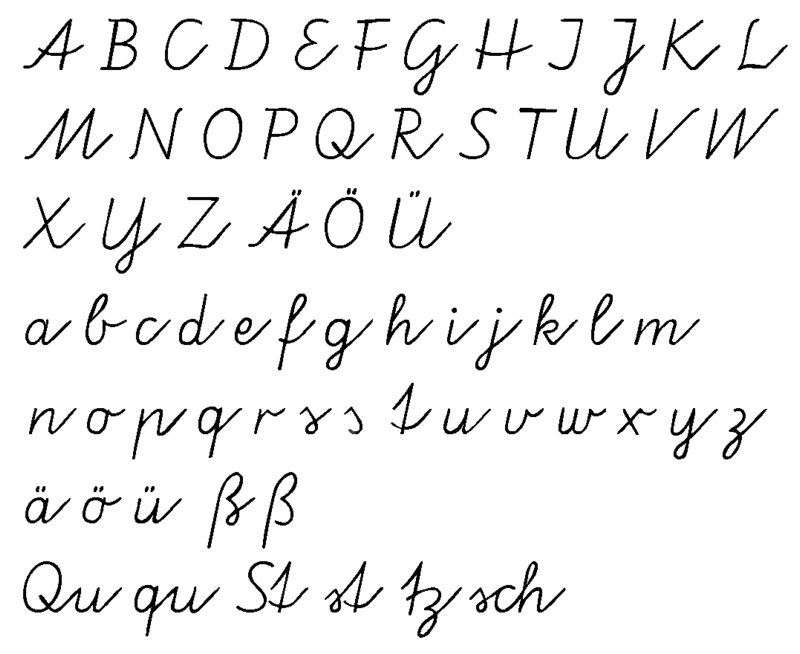
From Wikipedia: The Vereinfachte Ausgangsschrift (VAS, meaning "simplified initial script") is a simplified form of handwriting primarily based on the Lateinische Ausgangsschrift. It was developed in 1969 and tested since 1972. The letters have been simplified and the shapes approximated the block letters. In 10 of the 16 German federal states, it is available for schools to choose from, among other cursives.
It turns out that in the United States, too, cursive handwriting is on the decline. That's maybe not surprising given Sweden's current role as the "little United States of Europe", as some call it:
Numerous factors have impacted the declining use of English cursive in the United States. Largely, they have been technologically based, but in the 2000s cultural changes (such as diminished instruction of educators how to teach it) have also contributed to its marginalization. However, by the second decade of the 2000s "back to basics" movements have emerged advocating for its preservation.
Art schools
The argument to let children learn an instrument or learn to draw or other forms of art is simple and powerful: They can express what they would otherwise not be able to express. It's for a good reason that therapy uses drawings as a way to hone in on and understand children's issues and well-being.
Now while Malmö City in theory has great offerings through Malmö Kulturskola (literally Malmö Culture School), the reality is, again, that there's huge shortages. My own first-hand experience is that of a woodwind instrument teacher suffering burn-out because of too much work, my older daughter not being able to inscribe into courses around drawing that would very much interest her due to capacity. My younger daughter not being able to do piano lessons at Kulturskola despite having had private training on the piano for almost two years.
Sounds good on paper, in practice it falls apart with staffing and capacity problems. Should the kids instead pursue a different course that's less popular? Sure, that's how we ended up doing woodwind, and had the experience with the burned out teacher. It's a sad state of affairs, really. In a Swedish world with rising ADHD diagnoses (Karolinska Institutet, 2024: <https://news.ki.se/a-clearer-picture-of-adhd-focus-on-function>), sharply increasing reports of threats and violence in schools, anxiety on the streets, mental health issues at home, high divorce rates. And now, for lack of funds, children are losing one of their few remaining outlets. (See Sveriges Radio, 2025, citing the Swedish Work Environment Authority: <https://www.sverigesradio.se/artikel/schools-failing-to-stop-threats-and-violence-against-staff>; and Brå, 2024, on increased reporting rates: <https://bra.se/english/publications/archive/2024-08-27-serious-violence-at-school>.)
Well where's all that tax money going then, you ask? After all, Sweden has the 10th-highest tax wedge among 38 OECD countries. Well, to this question I'll offer an answer in another blog post.
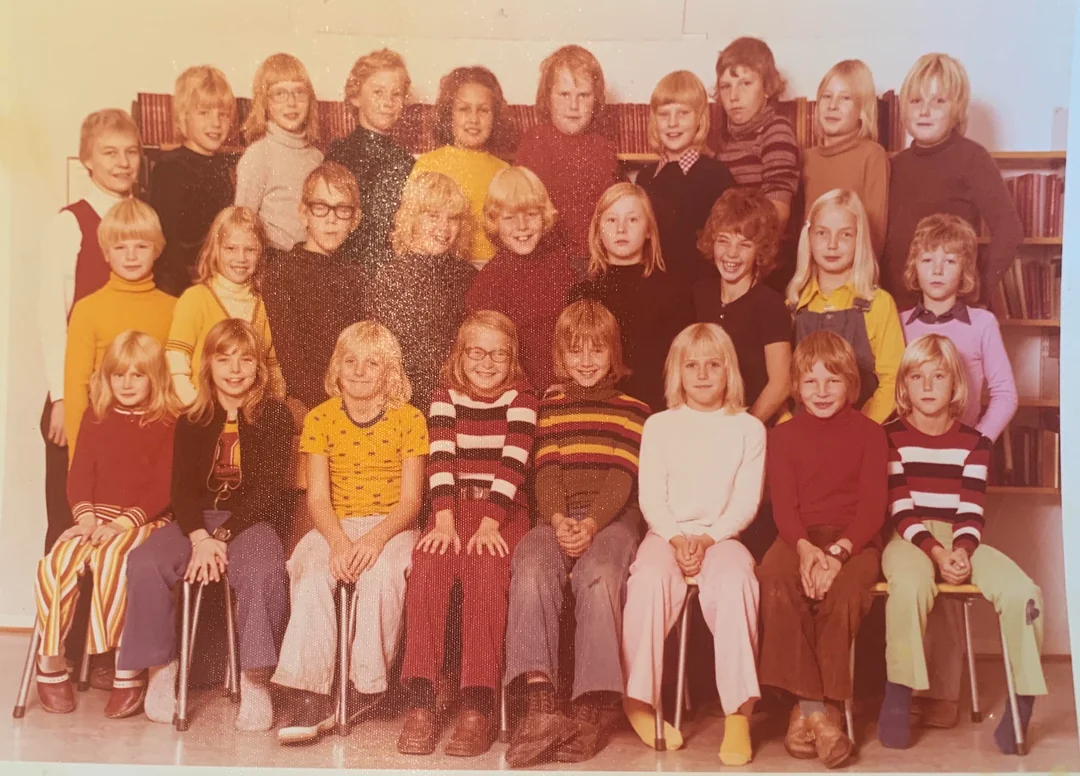
A school photo from early 1970s Sweden. Source
Note
Postscript: The description of Avdelning 88 has been updated to separate what I can document (the number, the 'shower man' doing a strange salute on the sign) from what I can only speculate about (intent). I've also appended a brief overview of IVO's findings and other reporting on suicides and patient safety in Malmö psychiatry, to show that what happened to Vicky sits inside a longer, well-documented history.